
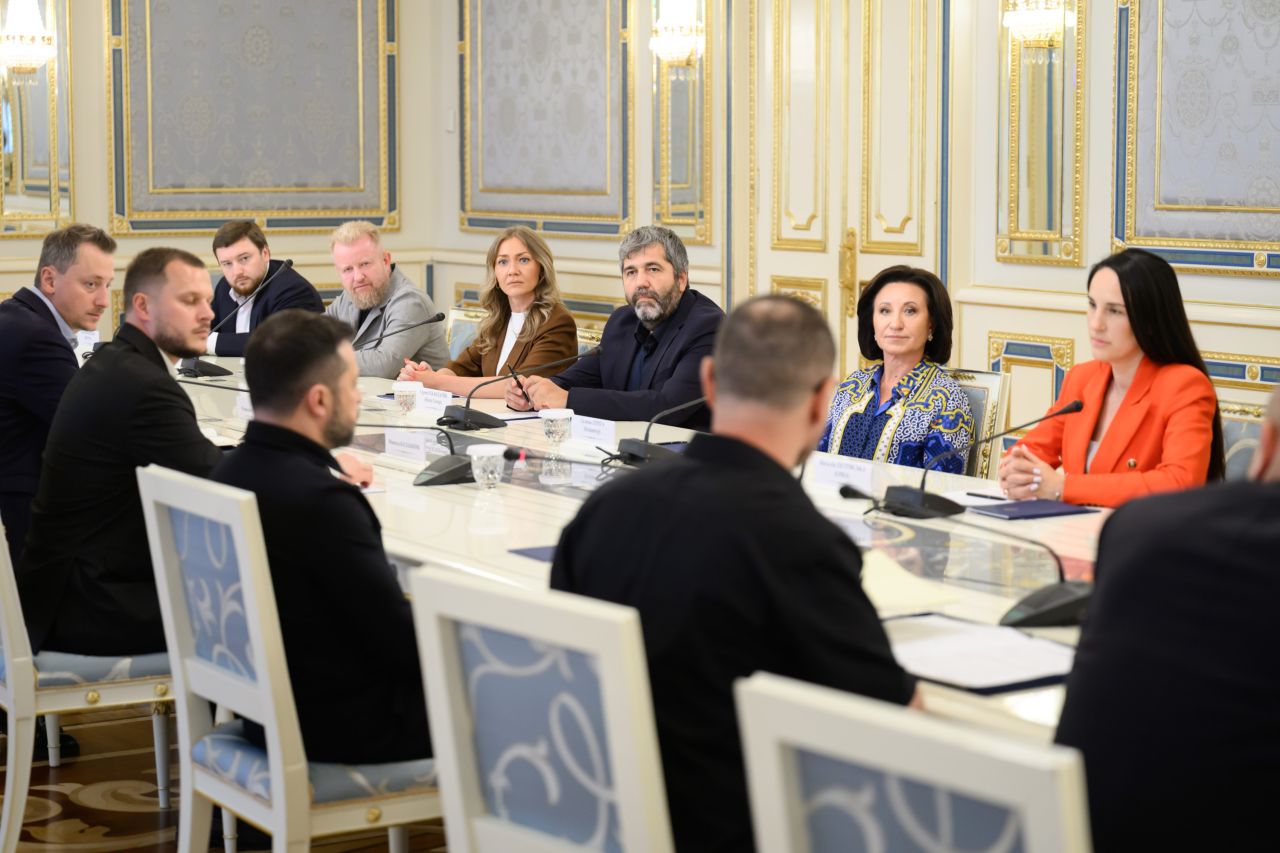
Ruslan Shostak, President of TERWIN, together with representatives of the Ukrainian retail industry, recently met with the President of Ukraine Volodymyr Zelensky.
10.09.2026
During the meeting, we discussed key business challenges amid intensifying Russian attacks and the concrete solutions needed to maintain the resilience of the Ukrainian economy.
In two hours with the President, we addressed issues that had accumulated over years and became critical for the sector as the intensity of Russian attacks surged.
Here is the breakdown:
1. Subsidized loans for large businesses affected by Russian strikes.
Today, large retail companies are virtually excluded from the 5-7-9% recovery program. Plans are underway to expand concessional lending to large enterprises that lost assets to attacks. This is a matter of principle.
When a warehouse or distribution center worth hundreds of millions of UAH is destroyed overnight, it is no longer just a single company's loss. It triggers a chain reaction across suppliers, settlements, wages, inventory, consumption, and taxes. This is precisely what the aggressor aims for—to ruin not just the facility, but the economic supply lines built around it. Providing large, systemic businesses with access to rapid recovery tools is vital for economic resilience.
2. New operational rules during air raid alerts.
A concrete solution is already in place. The government introduced tiered air raid alerts based on threat levels. Under the current attack intensity, the old framework effectively meant shutting down shopping centers continuously. In Dnipro, malls remain closed 90% of the time. This incurs losses not just for retail, but for the entire economy.
People's safety remains the absolute priority. However, economic activity should not automatically grind to a halt where actual threat levels allow operations to continue safely.
3. Protection of logistics hubs.
Recent Russian strikes made one thing clear: warehouses and distribution centers are no longer just commercial real estate. They are critical life-support infrastructure for the country. Losing a single distribution center can paralyze supply chains for hundreds of stores and wipe out inventory worth hundreds of millions of UAH.
Following the meeting, the Ministry of Defense and the Ministry of Economy will work on securing key logistics hubs vital to the economy. This marks an important shift in the state's approach to logistics infrastructure.
4. Backup international logistics.
Business leaders proposed establishing customs bonded warehouses in neighboring EU countries to store goods bound for Ukraine. The logic is simple: we cannot concentrate critical inventory in a few massive points inside the country and rebuild the entire supply chain from scratch after every destroyed facility. We need distributed, more resilient logistics.
5. Decentralization of storage facilities within Ukraine.
Another effort focuses on simplifying business access to vacant state and municipal warehouses. ARMA and the State Property Fund need to compile a clear list of available sites so companies can quickly disperse inventory.
6. Streamlined rebuilding of destroyed assets.
It is absurd when Russia destroys a distribution center in minutes, yet Ukrainian businesses need months of red tape to rebuild it.
The meeting specifically addressed deregulation surrounding the restoration of distribution complexes. Today, the speed of infrastructure recovery is not a bureaucratic issue—it is a matter of national economic survival.
Another fundamentally vital outcome is establishing systematic, ongoing communication between the state and the business community.
For me, this meeting exemplifies how state-business relations ought to be built today.
Because right now, the speed of government decisions is as much an economic asset as money, people, and infrastructure.